Monday, December 21, 2020

Margy


Margy was a new waitress at a railway-themed restaurant in Seattle when I first knew her. Railfan friends and I had been meeting at what we called "the Horse" long enough to have become friends with Charlie, the owner, his wife Mary, and other staff, so we were soon on good terms with Margy as well. We especially enjoying the awkwardness of her not being able to serve beer in the weeks until she turned 21, Charlie pitching in to do the deed legally. In her work uniform of bib overalls and train engineer hat, she looked young and boyish, and younger still in comparison to the woman, a few years older than me, who had recently broken off our relationship after a tentative agreement that we were working toward marriage.

In the aftermath of that breakup, I was frequenting "the Horse" more often alone, and Margy was easy to talk to, off the potential-relationship radar that might have made things difficult for me. She seemed an older version of my middle school student assistants of a few years before, rather than a younger version of women I had been socializing with.

Shortly after my personal breakup, Saigon fell, and with an Indochina refugee flood developing, the Army Reserve asked Civil Affairs unit members to volunteer for active duty running refugee resettlement camps. Soon I was at Fort Indiantown Gap, Pennsylvania, working 14 hours a day, 7 days a week - a good distraction. Regular Army "green berets" had established a "Civil Affairs Support Battalion (Composite/Provisional)" and were departing back to Fort Bragg. As the only senior enlisted person among the reservists who replaced them, I became the battalion Operations Sergeant, acting Headquarters Company First Sergeant, and acting Battalion Sergeant Major, with some duties quite literally "way above pay grade." My earlier experience as a Regular Army Military Police sergeant definitely helped in managing my young, civilian-minded, often cheerfully-unruly herd.

The MP background may have also been useful when the battalion hosted the occasional outdoor barbecue behind the building to promote better relations with the plethora of civilian agency representatives we worked with daily. While the unit commander was the official host, I had some backup hosting responsibilities, which included being unobtrusive bouncer when the well-polished garbage cans full of ice and canned beer neared empty. I gleefully observed the truth of the advertising slogan "when you're out of Schlitz, you're out of beer": the last few cans of as many as a dozen labels were always Schlitz, and when they were gone, the party was officially over. We had already started cleanup.

To keep things interesting, I volunteered to help with an ad hoc English language program, spending any lulls in my day finding volunteers from regional Army Reserve units at the post for their two weeks Annual Training. The quiet time driving around "FIG,PA" in my assigned Army pickup was a nice benefit, but it was also fun to visit the various "Under The Trees" groups in the evenings, occasionally groping in my minimal French to help with an English to Vietnamese conundrum. I would have done better in German or Russian.

As things wound down in the Fall, with only a few hundred refugees arriving and departing each day instead of the thousand or more of the summer peak, and with the last of the Reserve AT units departed for home, I found my job more and more difficult, rather than easier. Cumulative overload and autistic burnout. I was glad to head home. Back in Seattle, I found my civilian job had imploded. Or maybe that was mostly me.

Frequent solo visits to "the Horse" in the weeks that followed were excused as a need to get out of my apartment, to eat someone else's cooking, to be among people I liked. Newly unemployed, I was able to go in their quiet times and depart when things got unpleasantly noisy. Everybody else probably thought I was there to see Margy, and left when she got too busy to chat. If sufficiently pushed, I might not have denied that.

Longstanding adverse mental episodes became worse, then still worse. Mental aberrations used to be considered possession by demons. Talking therapy and pharmaceutical treatments have become the modern approach, but when things go bad, I still find demons to be the clear and present danger. Mental illness has seemed like a like a dark crystal, viewable as either demons, thought disturbances, or chemical disruptions, depending on how you look. Between that and the passage of time, my memory has a lot of blanks and confusion. Margy may not have been at "the Horse" before I went to FIG,PA.

The Friday after Thanksgiving that Fall, my grandmother hosted local and visiting family at a Chinese restaurant near Green Lake. I was encouraged to bring a companion, and took Margy. I was glad I did: she deflected quite a bit of noise and attention that might otherwise have intermittently focused on me. The next day, after the out-of-towners were gone, my grandmother died, alone, at home.

A few weeks before that, Margy and I had walked through a dark and drizzly downtown Seattle evening, ducking into a shadowy doorway to escape an unexpected downpour. As we waited for a lull in the rain and talked, I realized that I was looking down at the very appealing face of someone who clearly wanted to be kissed. I hesitated, with the irrational thought that I still wasn't completely sure that this person wasn't a boy, and kissing a boy could be a risk to my Army security clearance.

I kissed him anyway. A passing police car slowed to illuminate us with its spotlight, then drove on.

In the weeks after Christmas, I found myself spiraling into still worse mental health episodes. Margy told me she was planning a birthday party for me, and inviting her friends and my friends. I reacted with a barely-suppressed panic attack that I was unable explain to her. Disclosure issues had haunted me since childhood, exacerbated by virtually no understanding of Asperger's Syndrome to help explain sensory overload and related issues. It was quite simple in those days: if you were smart, you weren't autistic - You just needed to try harder. But I had no "try harder" left. I ended not just the conversation but all contact, without explanation. I was horribly rude, possibly cruel, at best eyerollingly dorkish.

And I was wrong, however it was received. I have no idea where things might have gone if I had allowed her to work with me. While I would not trade my life today -- my wife, my stepdaughters, my grandchildren -- for any imaginable alternatives. I know I should have tried much harder to talk with Margy. She was smart enough, kind enough, knew me well enough, that we both could have benefited. She was probably even better at being "goofy but sincere" than I was, and that's what we needed, not the deadly seriousness of depression. Whatever the ultimate outcome, it would have been worth the effort, worth the any penalties.

But realistically, that was an unlikely option. Both autism and endogenous major depression are lifetime conditions, with ebbs and flows that can be very constraining of behavioral options, especially with a lack of recognition and insight. My unfocused fears and abstract paranoia suddenly finding outlet in Margy's party proposal would not leave much opportunity for maneuvering. In later years, I would learn that as the slippery slope of a depressive episode tilted into the abyss, I would incrementally cut off contact with people. Eventually, long years later, I would learn to remind myself over and over that deep down, I still loved my wife, that the episode would eventually be over. That somewhere inside me I could no longer reach, I still loved her. And she was not at fault.

When I knew Margy, it was too early for any of that.

All the events involving her may have meant more to me than they did to Margy; I do hope so. I like to think that she simply got on with her life, sharing her wonderful laugh and quiet smile with others, while I poked and prodded my memories, trying to make sense of them. Trying to shine spotlights into shadowy doorways.

Sometimes being wrong is unavoidable. The best choice may not be good enough. The worst choice may ultimately be indistinguishable in outcome from any other choice. But still, the process matters. I will probably always be haunted by memories of the people I have hurt unwillingly, by having been unable to control my demons' enthusiasm for doing harm. I hope I have gotten better at that, but I still frequently see pain in my wife's eyes. I do know that I have gotten better at working on recovering the situation, rather than fleeing.

I grew up being called queer, retard, homo, sissy, fairy. I wondered how they could call me retard, when I was one of the smartest kids in the class. I wondered how they could call me queer, when I liked girls better than boys. I was over 50 when I finally got my Asperger's, Autistic Spectrum, diagnosis, and began understanding, then embracing, the retard label. The understanding of the queer label started earlier, developed more slowly, was embraced only recently with my still-developing understanding of non-binary and genderqueer, and my reading about autism and gender. Experiences in the homophobic Army certainly complicated the process.

Years of trying to fit in, find a lower profile, reduce the malicious taunting, follow autistic self-imposed rule sets, or to sort and line-things-up - all distorted my perceptions, including what kind of person was "best" romantically. Not long ago, I began a leisurely review of people I had been attracted to, of people who seemed to have been attracted to me. Looking for hints (or more) of possible non-bog-standard gender identity, and hints (or more) of non-bog-standard gender preference. So far it has been vaguely inconclusive (except for the people I already knew were LGBTQ+) but rather instructive, both within and beyond the original intent, and gradually became this picaresque ramble through the bowels of my mind..

The last time I saw Margy was when we unexpectedly approached each other crossing a sunny downtown Seattle intersection. We made eye contact. I looked away as she was breaking into a smile. My peripheral vision, as I walked past, permanently burned her expression of disbelief into my brain, along with my cringing feelings of shame. Autistic shutdown incapacitated me. I somehow managed to keep walking, but I would not have been capable of speech, or easily moving again, had I stopped. Or perhaps of ever leaving her again.

Years later, Charlie told me she was in Portland, married with two kids.

Internet findings suggest she died in her early forties.


[names have been made less specific to deter internet search engines]


x

Friday, April 24, 2015

Shelf E


When I showed this picture to Jo, she asked why I was grumpy.

My dad used to tell a story about when he was a little boy, he once asked his mother why she frowned so much, was she unhappy about something? She replied that she wasn't frowning, that's just the way her face was.

Sunday, December 8, 2013

Breakfast

At Kathryn & Andy's for family breakfast.

Monday, November 4, 2013

Sun & fog

 When it's sunny in Seattle, it can be quite special.

Also when it's foggy.

Thursday, February 28, 2013

Snoqualmie Pass


One hours drive from our front door we can be thoroughly in the mountains (or in ten minutes walk to a tidal beach - I get to the beach more often).

Looking across to where the old road disappears beneath the (ice- & snow-covered surface) of the later Lake Keechulus.

[This is the fourth (and probably final) post of places along my solo daytrip yesterday]
Posted by Picasa

Wednesday, February 27, 2013

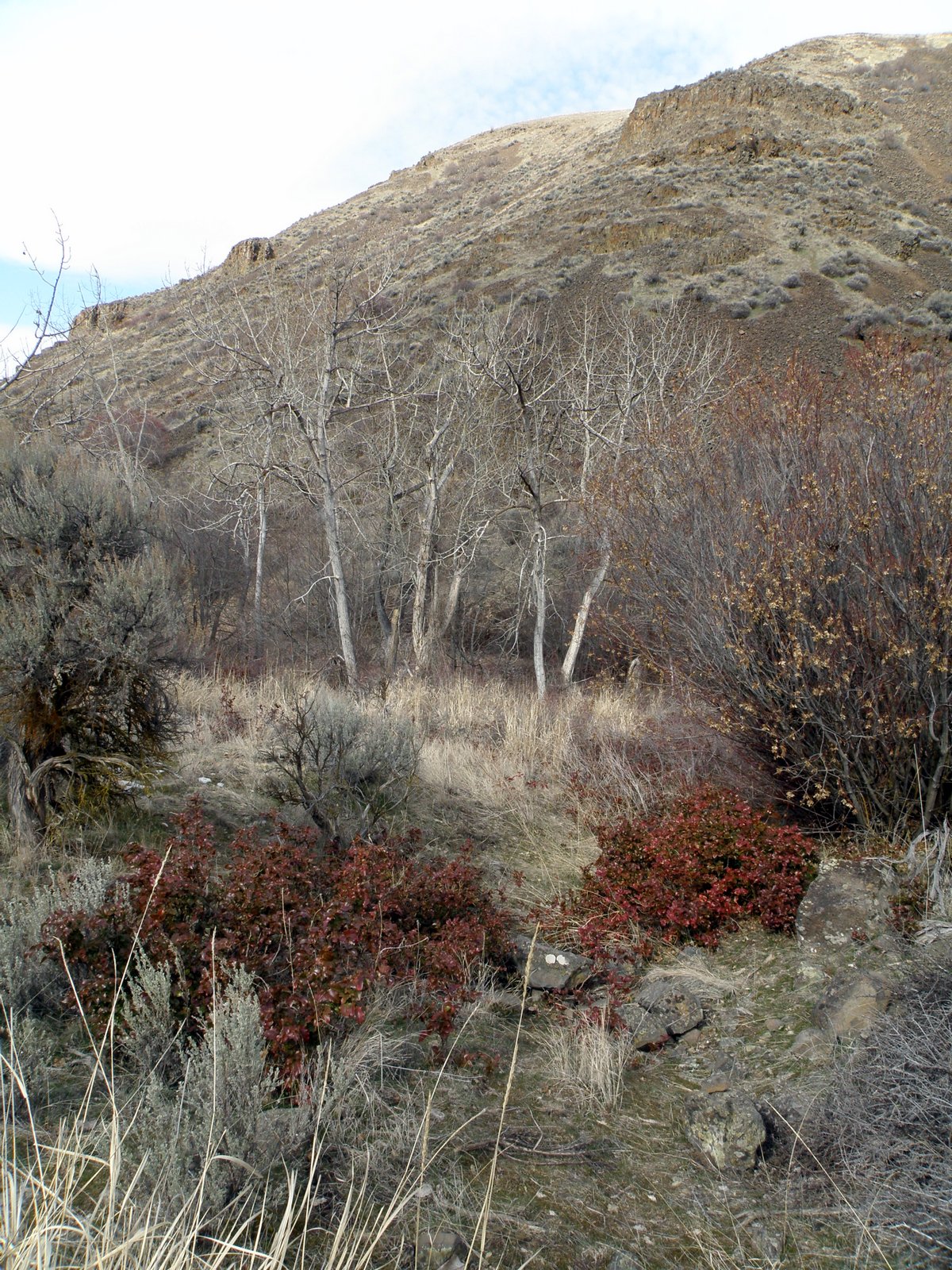
Umtanum Creek

I have loved the Yakima Canyon since I first drove through it in April, 1975, on my way to an army training course on counseling that would eventually have a profound impact on my life.

Umtanum Creek, which flows down a long side canyon into the Yakima River, has become one of my all-time favorite places.


Pedestrian suspension bridge across river from parking & picnic areas along Canyon Road


Cacti, ~2" high. This may be the same group that I photograph every visit.


The old Northern Pacific line from Seattle & Tacoma comes over the mountains from Auburn via Stampede Pass, then follows the Yakima River to Richland, where it turns north to Spokane, before heading through Montana to Minneapolis-St. Paul.
 

About a mile up river from the Recreation Area, I found an empty tank train coming towards me. BNSF's Stampede Pass line is now used to move various trains of empties East.
 
Posted by Picasa

Point B


I posted yesterday with an old lousy picture from this location, this panorama might give a better idea of what can be seen [click for larger image]. The BNSF (ex Northern Pacific) wraps around below us on this side of the river. Track is visible to left and right, and in the distance just right of center. What appears to be a rail line going into a tunnel on the other side of the river is the Iron Horse Trail (ex Milwaukee Road Railway).

Oh - and a primary mission today was to determine how hot & tasty a hamburger from the Dairy Queen in Cle Elum would be after driving here, and finding a suitable sitting spot on the hillside. Still hot. Very tasty.

West Nelson Siding Road


East on the BNSF [ex-Northern Pacific]

West on the BNSF [ex-Northern Pacific]

West on the Iron Horese Trail [ex-Milwaukee Road]

East on the Iron Horese Trail [ex-Milwaukee Road]

Map

Tuesday, February 26, 2013

Twilight & a river

In last night's dream I sit on a hillside above the Yakima river east of Cle Elum.

Someone is with me. Probably my wife Jo, perhaps one of our adult daughters, or my sister, or a friend, but certainly someone I am entirely comfortable with.

It is twilight.


The canyon is almost entirely in darkness. There are lights at a distant farm. The river catches the last light from the sky and reflects it back.

For sharp eyes, thin lines of light reflect from the railroad tracks, where the railheads have been polished by passing trains.

We have been talking quietly since before sunset, sitting just above where the hillside's slope breaks into near cliffs.

Now we are silent, listening to the distant sounds of a train approaching from the east - first the diesel's horns sounding their way through Thorp, then the growing throb of the diesel engines themselves.

A glow from the locomotive headlights gradually appears, then their bright illumination appears on the opposite side of the river, briefly restoring near-daylight to a sweeping patch of hillside and river and trees.

The train rounds the bend from our left to pass beneath us.

We watch and listen as the noise of the heavy diesel engines fades and the train continues beyond us, replaced by the steadier rumble & random metallic creaks of the loaded freight cars. A final surge of diesel noise marks the passage of the rear-end locomotives, and then the sounds gradually fade again.

Coal train.

The distant murmur of the river reasserts itself.

Monday, May 28, 2012

Lilli Marleen

Underneath the lantern,
By the barrack gate
Darling I remember
The way you used to wait
T'was there that you whispered tenderly,
That you loved me,
You'd always be,
My Lilli of the Lamplight,
My own Lilli Marlene


In World War II, every country had it's song that more than any other "spoke" the mood. For most countries, that song was not Lilli Marlene.

Vor der Kaserne
Vor dem großen Tor
Stand eine Laterne
Und steht sie noch davor
So woll'n wir uns da wieder seh'n
Bei der Laterne wollen wir steh'n
Wie einst Lili Marleen.


But throughout the countries involved in the European war, on both sides, in many languages, Lilli Marlene was at the very least a close runner-up, and by being so widespread surely qualifies as the leading song of that war.

The version that first pushed Lili Marleen to fame was by Lale Anderson, who was born in Bremerhaven, Germany, in the Lehe district.

In 1971, while with Det B, 42d MP Gp (Customs) at the US Army installation in Bremerhaven-Weddewarden, I had an apartment in Bremerhaven-Lehe, on Artilleriestraße, named for the artillery barracks or Kaserne that was across from my kitchen window. I looked down into its courtyard. Lale presumably grew up knowing that same barracks as "the Kaserne," and its gate may have been what she pictured as she sang "vor dem großen tor."

I wish I had known that when I listened to Marlene Dietrich singing Lili Marlen in my tiny mansard apartment.

I certainly thought of the song when I looked at that gate.

Lili Marleen An Allen Fronten has 184 historical recordings of different versions on 7 CDs. I wish I could get that out of the Library. Maybe my kids will get it for me for Father's Day? Nah.

Today is Memorial Day, and I think of my father's friends who died in that war, my friends who died in Vietnam, family and friends who have served in Iraq and Afghanistan and lost friends there. Of everyone who has lost family and friends in any war.

I watch our flag dance in the breeze.


Saturday, May 19, 2012

Hildegard Knef

I was sitting on the couch this morning, taking another break from reading Stasiland - a wonderful but heart-shearing book of stories of secret police victims da drüben, as the DDR was known to us then - and apparently my mind circled out from those times and my post yesterday about Katja Ebstein.

The name "Hildegard Knef" came into my aimless drifting.

For a moment I wasn't sure if I remembered her as actress or singer, but a quick Google search confirmed she was both, and the opening bars of  the first YooToob clip i played - Ich brauch' Tapetenwechsel - went deep into my soul (even if the English lyrics seem a bit goofy) - it was on the record I had. As was the second - Insel meiner Angst.

For both songs, I had to move away from the computer, standing stiffly in the door of the room, muttering "holy shit" under my breath.

In various episodes of mental illness I sent versions of myself through my brain like herds of crazed wolverines followed by Attila the Hun's Mongolian Hordes* equipped with weed-eaters, attempting to rid myself of whatever memories drove me toward the abyss. I never seemed to have much success at the intended goal, but many times in the last decade of therapy I have learned how much of the good was chased away in my ineffectual attempts to destroy the evil.

I went back to the attic, but didn't find the Knef album. Is it gone?

This post is taking me a long time to assemble, interspersing writing with crying, walking around the house, listening to the same songs again, finding more, for Im achtzigsten Stockwerk, I again had to move away from the computer, to stand in the doorway mumbling.


So, I am ordering the CD of  my old Knef album, and looking to see what else I might like to get, in the affordable range.

I think now that when I found the Katja Ebstein album in 1971, I was looking for something to keep me from playing Knef over and over again - and like Mike, I think I was initially disappointed.

What I don't remember at all is why I never asked either Ruth Gottwalles or Claudia Haase to help me find some more music that I would like. Did we only talk about the music we enjoyed in the Tanzbars, not what we enjoyed on our own records?

Bremerhaven. Helmstedt. Braunschweig. Zonengrenze. Zollfahndung. Da drüben. Dienstfahrt im Sowjetischen Besatzungszone. Feierabend.

Long, long ago.

__________________

* Back when I was young & oblivious I once wrote: 

I was crazy when I started,
I'll be crazier when I'm done
that's why they call me
Attila the Hun

If you ever find yourself with even a remotely plausible belief that you have mental health problems, get therapy now. Do not let decades go by. If not for yourself, then for those who might attempt to love you.

Friday, May 18, 2012

Katja Ebstein

In Bremerhaven, sometime in the first half of 1971, I was trying to find more record albums by German singers I might like, and came across Mein Leben ist wie ein Lied [My life is like a song] by Katja Ebstein.

Although I had no idea what she sounded like, I was sufficiently curious how Simon & Garfunkel's "I am a rock, I am an island" sounded in German [Ich lebe allein auf einer Insel] by a female vocalist, that I bought the album.

Sometime after that, I was relocated to Helmstedt, where after hearing the Album a few times, my roommate, Mike Matson, commented "I always assumed you bought this for the cover photograph, but I'm beginning to really like her singing."

Yes.

As we can see on the album I recovered from the attic this morning, she really does have a great nose. Edgar, who also has a great nose, and has reason to appreciate them, seems to agree. Also, the color green also appeals to both Edgar and me. Edgar is a German Igel [hedgehog], so I can't imagine why Katja is looking at him with such suspicion.

Yootoob has a fine clip of her in 1972, at age 27, singing that album's lead song, Und Wenn Ein Neurer Tag Erwacht.

Since neither of my regular readers understands German, and I had a bit of trouble following the lyrics myself (tending instead to just drift into enjoyment of the voice), here is my heavily edited version of the Google translation of the German lyrics found on the web:

And when a new day awakens

Hopeless
without purpose or meaning
you go your way
and you do not know
where it leads.

Hopeless
so often in a beginning
but what comes tomorrow
is in your hands
remember that.

And when a new day awakens
from the dreams of a night.

You feel all at once, free again.
And when a new day awakens
and the sun again will laugh
the great loneliness is long behind
long behind, long behind.

Hopeless
you see your world
and you ask
why
someone does not hold to you

Hopeless
you should not be
for there comes a time
that you are no more alone!

And from 2007, when she was 62, "Wölfe und Schafe" ["Wolves and Sheep"].

I had no idea until yesterday how many albums she had done prior to mine (maybe one, maybe three) or how many total she has done now - 40 if i counted correctly at Wikipedia,  or 15 (+ 3) per a web discography.

Either way, I have missed a lot of fun over the intervening years.

A greatest hits CD I ordered the other day arrived moments ago and is now playing in the living room, so time to wrap this up and go listen.
___________________
addendum

After I played the CD, repeating a few songs, I thought it would be nice to at least play the LP once, especially after taking a look at the song titles on the back (image above is blown up and reconfoogled from the album back, click for large, legible version). So I uncovered the turntable, which seems to have last been used several years ago to play Linda Ronstadt's version of December Dream, and got it working. But after that exercise, I am ready for some quiet. I'll comment here again after I have played it.

Okay. Ummm. I found myself several times wondering what SGT Winston & SGT Matson were thinking. I now am pretty sure that Mike concluded I had bought it for the cover photo AFTER listening to it the first time. The arrangements are appalling & some of the songs are ridiculous - but then again, the voice, and her German, are quite wonderful at times, and I suspect at that time we would not have preferred her more mature voice had it been available.

Further thought reminded me that it was a change of pace from Country Joe & the Fish, Jimi Hendrix, Cream, Julie Driscoll, even Marlene Dietrich. Many others*. But I still think the meine größten Erfolge CD is much, much better.

 * Hildegard Knef!

Om Oy

Every now and then I come across a picture in a book showing a sign that says "Om Oy," and for a moment I gaze at it without comprehension. Sooner or later though, I realize that it is actually "0m 0y" (zero-m zero-y), and the British counterpart to an American "MP 0," or milepost zero.

That American railroads mark their lines in decimal fractions of a mile (eg "MP 8.4") while the Brits used miles and yards (they may still, or may have converted to metric) is interesting enough to let my mind idle on that for a bit, after which I mostly move on to other items of interest in that or subsequent photographs.

Recently though, a friend and I shared a brief discussion on "it's about the journey, not the destination," and my brain has turned that cliché into a journey, rather than a destination, categorizing random appropriate and inappropriate items into one or another or both. 
  • Journey: knowing oneself, loving another, walking on the beach, reading a book
  • Destination: root canal repair, surgery
  • Either or both, depending on your attitude, your mindfulness: eating, driving somewhere,  writing a blog post, most any part of life?
In that context, a "0m 0y" sign in a photograph jumped out at me this morning as signifying not just a starting point, but a destination - after all, most milepost-zero signs are located at the major terminus of the railway line, which is a destination for a large number of travelers on the railway.

So I wondered how often "it's not about the journey, it's about the starting point," and of course, how often is our destination actually our starting point?

We shall not cease from exploration
And the end of all our exploring
Will be to arrive where we started
And know the place for the first time.

My instinctive reaction to that is "I don't want to go there."

"Vicious circles"

"Viscous circles."

Trapped in an infinite loop, revisiting the same cycles of despair and frustration.

But then again, I am always happy to get back home to our cats, who typically ignore my arrival unless it is near their feeding time (a several hour window that rises steeply in intensity when they fear that I might be late or gone forever).

And often I am pleased to awaken to a new day.

But now the kitties are expressing concern that I might not return from the journey into blog-posting-land until their breakfast is exceedingly overdo, and I have not yet hshowered (journey? destination? both!).

So I shall click "publish" and walk away from the computer.


Friday, April 13, 2012

Basin & Range

In 1977, I made a bunch of trips out of San Francisco in various directions (though not West), and several of those involved flying over the Basin & Range country of Nevada - if not quite the route(s) of the Lincoln Highway referred to in recent post, then at least very similar country.

 I found it daunting to gaze out the window and trace roads that climbed & wound over one obstacle, only to descend, cross a lonely, unoccupied valley, and climb again.

Nary a car in sight over most stretches of road, and even then, more likely to be a pickup. Battered, or soon to be.

In those pre-cell-phone days, I wouldn't have wanted to drive a car through there. Not sure I would now, given what I recall of cellular coverage maps, unless I had a DeLorme Earthmate PN-60w + inReach for satellite messaging.

Some may say "no guts, no glory," but I'm not sure I ever was looking for glory, and I'm certainly not now.

I devoured John McPhee's Basin and Range when it came out a few years later. Now I can't find my copy, so I am guessing that after twenty-five-plus years of taking up shelf space, with only the occasional glance, it went to a used book store two or three years before I was finally ready to read it again.

A copy will be here from the library in a few days, and if anything, the lesson is that I could have parted with it much earlier, not that I should have kept it.

I'm tempted to look for a used copy of the Delorme Nevada Atlas, though, since the only library copy is restricted to those able to visit the Seattle Public Library's downtown Temple, and is not available to us scruffy users of the branches.

I imagine tooling along in an entirely adequate & reliable vehicle, simply enjoying the scenery, the nature, the road ahead and behind, the traces of human interaction with the land, of settlement persistent or abandoned. Birds, trees & shrubs & flowers, geology. Photography.

Not that having it is critical for what is unlikely to be more than a fantasy road trip. One with PN-60 + inReach, in-car naturalist & co-driver, and of course unlimited funds for lodging, meals, car repairs, & tacky souvenirs.

Guess I'd better buy another lotto ticket some time.

Tuesday, April 10, 2012

Skateboards

I saw a guy skateboarding yesterday who had a beard that was mostly gray. He looked like he could have been my age, but was probably a few years younger.

There aren't very many skateboarders my age.

When I was a younger kid, on the urban streets of Portland, the closest thing to a skateboard was the two halves of a metal roller skate (the kind with the adjustment key) nailed to the ends of a two-by-four. Properly, there was supposed to be an apple crate nailed on end to the front of the two by four, with a narrow board nailed across the top to provide handles.

They could be pretty fancy.

But sometimes, because the box came off in a mishap, or because apple crates were becoming harder to find, or because of sheer impatience, kids tried to ride on just the bare board.

It didn't work very well.

So I was surprised when we moved from rural Lake Stevens to the suburban hills of Lake Forest Park in 1962, or maybe a year or two after that move, that there were a few kids riding similar boxless devices where a piece of plywood had replaced the two-by-four. It was flat, but had some rounding on the ends, and apparently some flexibility in how the skates were mounted.

And it worked much better.

The fancy tricks came later, but apparently the journey was underway, and some kids my age were part of it. But I didn't see students commuting to college classes for a few more years after our age group, and it seems like the folks who did that are the ones more likely to still be doing it as grandpas.

Not that there aren't probably skateboarders in their eighties who were already too old for such foolishness when they started in their thirties.

I don't think I am about to take up skateboarding now, but I think I will continue to do things that qualify me for 'to old for such foolishness.'

And make a point to try out some new foolishnesses every now and then.

Thursday, April 5, 2012

Old Highways

When I was a kid, my dad would routinely point out "the old road" as he drove the family on some highway or another.

In the Columbia Gorge, the Old Road was a true classic - the Columbia River Highway, built between 1913 and 1922 as America's first Scenic Highway - but even in other areas, WPA era two-lanes had more romance than the modern, 1950s, four-lanes.

In the sumer of 1958, we took a long family car trip from Portland, Oregon, to the Philmont Boy Scout Training Center, in New Mexico, where my dad was to take a course. There & back was a scenic tour of Western National Parks and areas in between. Largely on two lane highways, some of which may have been the true, classic Route 66 - but most of which had that flavor, even if we were actually going south or north, in other states.

Less than fourteen years later, driving my own car from New Jersey to Portland in January, I chose an Interstate-20 route to avoid as much winter weather as possible, but when I now read about Route 66, I recognize that I was witnessing the last of the classic era in places, though at the time I thought it was long gone, buried under the Interstate.

Even in 1958, we had stretches of new-built Interstate, with more areas of construction. By 1972, the only place I recall being on 'the old road' was between Atlanta and Birmingham, where long stretches of two lane wound through small towns with many right-angle turns - but many stretches were on detours and shoo-flies among massive Interstate construction projects.

In 1975, riding with a friend from Fort Indiantown Gap, Pennsylvania, to Kearny, New Jersey, the "Lincoln Highway' markers along an elderly stretch of divided highway were only mildly intriguing, but when I came across a Lincoln Highway book the other day, I was more than intrigued, and immediately requested it and another from the library. A third, I had to order since neither local library system has it & I was excited enough to want one to keep on my shelf, and $10 for a used copy seemed reasonable enough, though it will be hard for it to measure up to Greetings From The Lincoln Highway: America's First Coast-to Coast Road.

Encouraged by some recent discussions of Road Trips, I found myself evaluating the Lincoln Highway in Nevada & Utah as road trip possibilities - as implausible as it might be for me to go there myself, with the medical and mental disability constraints, it is still great fun to read about and explore in maps and pictures.

In the 1960s and 1970s, most drivers were just relieved to have the ease and speed of the new Interstates, but even then, there were folks dedicated to exploring the byways and bypassed towns and scenery. Now Old Highways themselves seem to have become a minor, but nontrivial, interest area of their own.

I'm waiting for Road Trip USA: Cross-Country Adventures on America's Two-Lane Highways from the library. Maybe it will have a bibliography.

Seems like there is a lot more fun yet to be found in this topic.

Sunday, April 1, 2012

Dry side wet


For many of us on the Wet Side of the mountains, going to Eastern Washington is a desirable outing because it gets us some sunshine.

But on Friday, the Dry Side was just about as wet as the Wet Side - and has been really wet all over the region.

But we had fun nonetheless.

My first challenge is joining up with my daytrip companion, Chris, which requires more driving than I normally do - and is a commitment to driving myself back home afterward that for disability reasons is not always an optimal choice.


But I did it, albeit with a "turn around & come back home option" that left things up in the air to a degree that would discourage most folks trying to plan a day.


Even once I was there, we didn't decide right away that we were going to go over the Pass, but after an early lunch, we decided to go for it, with Chris driving.

There was much snow on the approaches and summit to Snoqualmie Pass, but it was a fun drive even with rain coming down.

By about Easton, our dog-like companion, Floyd, was indicating a need for a potty break so we
stopped at West Nelson Siding Road and walked east on the Iron Horse Trail (one of the Best Rail Trails around) a bit, in intermittent light rain.

Still having an urge to travel, we headed east to Thorp, mostly in rain until the very end. But crossing the summit at Elk Heights, East of Cle Elum, puts one in open country that looks very much like The West of film and legend. It seems to be somehow good for my soul.

Thorp was fun & Floyd went wild - it must strongly resemble where he spent his puppyhood
in Northeastern Washington. He very much wanted to get out of the car & go herd cattle. He was so engrossed in the cattle that he missed the sheep on the other side of the car, not to mention a herd of twenty or more mule deer very close to the road in an open field.


Before we found someplace we wanted to walk, we were back in the rain, so decided to head back west on old US 10 toward Cle Elum - great views of the Yakima River in a canyon below with railroad on one side and the Iron Horse Trail passing through old railroad tunnels on the other.

Back on I-90, we drove West through rain again to Golf Course Road exit (formerly East Nelson Siding Road) which didn't quite grab us, so we followed nelson siding road - fun!
- back to the west end and walked West from the same place we had earlier Walked east.

That was also quite nice - at least visually and in nature studies, if not on the ears - it's maybe a bit too close to i-90 traffic noise, though I appreciated the proximity to the active BNSF line. Even if there weren't any trains while we were there, they were at least a possibility - rare on a Rail Trail.


Well satisfied, we headed back over the pass. Back at Chris's, I quickly hopped in my car to try to get home before the traffic got too miserable, but apparently it had gotten miserable without me. But I still made it home okay, and quite pleased with the accomplishment and especially the outing.

Great fun & very good for my head.

Sunday, March 25, 2012

Old Paint

I grew up on the wet side - the 1950s in Portland, since then near or in Seattle, except for college and military excursions.

One strange thing about that is that is that "The West" as seen in movies, on television, in stories and song, or at least places that pretty much looked like that, is somewhere gotten to by driving East.

I seem to have a special affection & affinity for those lands, perhaps especially those that aren't quite the places of typical Westerns.

Oregon and Washington are both divided into East and West, with the dividing line being the Cascades, and sometimes taken specifically as the Cascade Crest. By that narrow line, I was born in Eastern Oregon, but Hood River is in the Columbia Gorge, a gap (monumental, shaped to extravagance by the Missoula Floods) in the Cascades, and within the transition zone between Wet Side and Dry Side. The Hood River Valley is a place of orchards - apples and pears - similar in many ways to the East approaches of Stevens Pass - Leavenworth & East: Peshastin, Dryden, toward Wenatchee and the Columbia River (again).

Montana lives richly in my personal mythology: my middle name coming from Brady, Montana, and my parents having moved to Hood River from Western Montana, where my sister was born. Though our older brother, and our father, and his mother, were all born in Seattle, and our mother in Portland, though she also grew up in Seattle.

I often sang "I ride an old paint" to my girls as they attempted to grow up under my adverse influence, and the hero of that song is "off to Montana" in a cowboy way. Yootoob has many versions ranging from Roy Rogers to I-don't-know, but I just listened to Linda Ronstadt (whom I have loved since she was a Stone Poney) and that will do for the words and tune, though it isn't quite the feel I aspired to, perhaps Rex Allen? Especially since I have been indulging in Singing Cowboys this last week or two.

My ramblings here today have no particular purpose or destination, except that I keep feeling my need to go East and get a little West, a little dryside. My sister & I are exploring the possibility of a daytrip. Soon maybe. With pictures to show for it.


Saturday, March 17, 2012

Channeled Scablands

This is the time of year when my thoughts turn to dryside outings.

Living on the wetside, with a beach nearby, is my strong preference, and outings to the mountains are a lifelong favorite, but trips to the rain shadow extending from the East slope of the Cascades are right up there, and this year an excellent new book, Washington's Channeled Scablands Guide, has gotten me even more stirred up.

Having had no trip last year because of the aftermath of chemo has also boosted this year's desire.

So today I pulled Cataclysms on the Columbia: The Great Missoula Floods and Glacial Lake Missoula and Its Humongous Floods off the shelves for re-reading, along with Bretz's Flood: The Remarkable Story of a Rebel Geologist and the World's Greatest Flood for more history (also Kindle),  and On the Trail of the Ice Age Floods: A Geological Field Guide to the Mid-Columbia Basin, which is mostly south of much of my favorite territory, but does include such favorites as Lower Crab Creek, Frenchman Hills, and the Drumheller Channels, and in the rest is still very interesting. It will soon be followed by The Northern Reaches in Volume 2 (and maybe, perhaps, someday, The Columbia Gorge and Willamette Valley, in  a third volume?).

Wonderful reading about how huge floods hundreds of feet deep and tens of miles wide surged across eastern Washington about 50 times from about 15,000 years ago to 18,000 years ago, as a glacial dam which flooded extensive valleys in Western Montana broke and release hundreds of cubic miles of water over a period of just a few days, to carry icebergs to the southern reaches of the Willamette Valley. Then the glacier would close the gap again, the lake would refill, and it would all repeat.

There are even videos: NOVA: Mystery of the Megafloodwhich I found problematic in places, but still worth watching, and The Great Ice Age Floods, which I haven't seen but is on the way.


But even better is visiting: Whether driving tours, short walks, strenuous hikes, or even kayaking, there are all sorts of opportunities to enjoy the scenic and geologic delights, and imagine water pouring through gaps in the ridge-lines high above - unless you have strenuously hiked up there and are looking down across wide expanses of countryside scribed by visible relics of dry waterways from thousands of years ago.

There are few places where the evidence of dramatic geologic forces is so easily and widely visible.

And of course the wildflowers, lakes, and modern waterways also add to the charm. Best Desert Hikes, Washington, is another useful title, for within and near the flood scablands and coulees.

It's time to go back!

[I intended to include some of my pictures in this post but Picasa seems to have forgotten all my photographs over a year old so it will take a day or three's digging - check back!]


Travelers

A day or three before a vet trip, the carrier comes up stairs where the cats can get used to it & forget that its coming upstairs leads to a trip to the vet.

This picture is after Archie (left) had his visit to the vet, but Webster (in the carrier) still hasn't been (Archy and Mehitabel?).

I had hoped to get a better quality image, with cheerier attitudes, but haven't caught the two of them together.

Archie has spent some time lying in it, but I don't think he's slept there yet.

Webster often sleeps soundly, sometimes with his back to the door. He'll get his trip this week probably, and we'll see how his attitude changes.